Earn Your DPDPA Certification
Learn and take the self test of your knowledge of the Digital Personal Data Protection Act, 2023 and DPDP Rules, 2025 through our comprehensive three-phase assessment program.
Assessment Information
Self-Assessment Tool
This is a free self-assessment tool designed to help you test and enhance your understanding of DPDPA 2023 and DPDP Rules 2025. No fees are charged for taking assessments or receiving certificates.
Assessment Content
All questions are based exclusively on the content available on this platform, derived from the Digital Personal Data Protection Act, 2023 and DPDP Rules, 2025. We recommend reviewing all materials before attempting the assessments.
Open the Essential Study Guide →Three-Phase Journey
Progress through comprehensive assessments designed to validate your DPDPA expertise
Certificate Eligibility Requirement
A minimum score of 75 out of 100 is required to receive a certificate for each phase. This benchmark ensures that candidates demonstrate comprehensive knowledge and understanding of the Digital Personal Data Protection Act, 2023 and DPDP Rules, 2025.
Phase 1
DPDPA Foundation Certified Professional
Comprehensive understanding of DPDPA 2023 fundamentals, consent framework, individual rights, and basic compliance requirements.
Phase 2
DPDPA Compliance Practitioner
Advanced knowledge of Significant Data Fiduciary classification, DPO obligations, international transfers, breach management, and DPDP Rules 2025.
Complete Phase 1 to unlock
Phase 3
DPDPA Compliance Expert
Expert-level mastery of penalty calculations, strategic compliance, complex governance frameworks, and advanced audit methodologies.
Complete Phase 2 to unlock
How It Works
Choose Phase
Select your certification level
Complete Exam
Answer 100 MCQs within time limit
Achieve 75%
Score 75 or higher to pass
Get Certificate
Download instantly & share
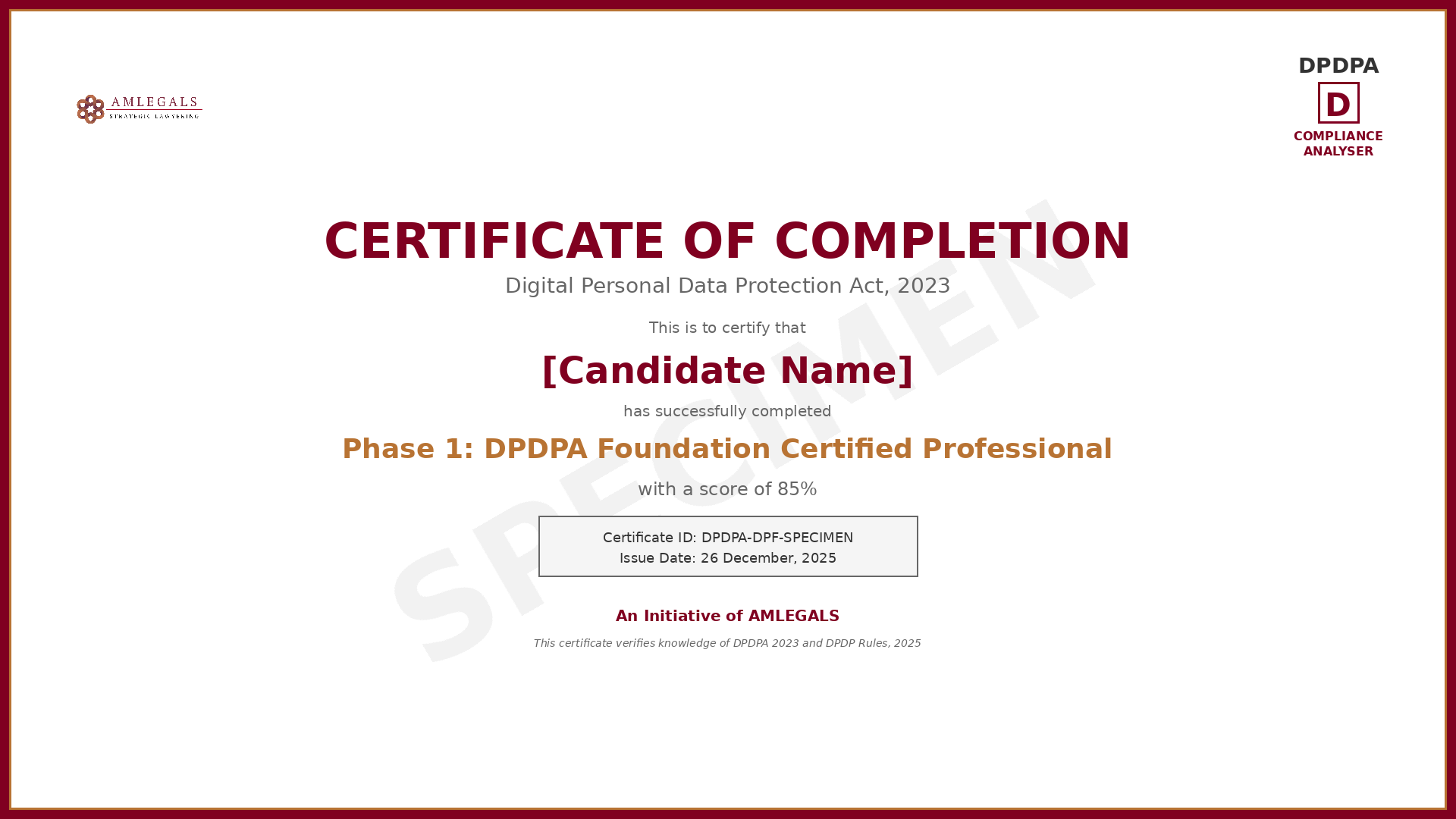
Professional Certificate Preview
Upon successful completion, you will receive a professionally designed certificate that you can share on LinkedIn and other professional platforms.
Instant Download
Download your certificate immediately upon passing the assessment
LinkedIn Ready
Optimized format perfect for sharing on professional networks
Unique ID
Every certificate includes a unique verification ID
Frequently Asked Questions
Essential information about the DPDPA Certification Program
Who can take this certification?
Anyone interested in DPDPA compliance can take the assessments. This program is ideal for privacy professionals, data protection officers, legal counsel, compliance officers, business owners, entrepreneurs, students, and career professionals seeking to demonstrate their knowledge of the Digital Personal Data Protection Act, 2023.
How are questions sourced?
All questions are based exclusively on content from this platform, derived from the Digital Personal Data Protection Act, 2023 and DPDP Rules, 2025. We strongly recommend reviewing the diagnostic tool, best practices guide, implementation playbook, FAQ section, technical codex, and white papers before attempting the assessments.
Is the certificate recognized?
Certificates are issued jointly by AMLEGALS and DPDPA Compliance Analyser. While not a government certification, they demonstrate knowledge and understanding of law as it is aimed at making one learn about the objective, operational, and mandatory provisions of the Digital Personal Data Protection Act, 2023 and DPDP Rules, 2025.
Can I retake if I fail?
Yes, you can retake any phase immediately. There is no waiting period or limit on attempts. Take your time to review the materials and attempt the assessment again when ready.
Is my data stored?
No. We follow a strict zero data retention policy compliant with DPDPA 2023. Your name is used only to generate the certificate PDF and is immediately cleared from memory after download. Only certificate metadata (ID, score, date) is stored locally in your browser. We do not use tracking, cookies, or engage in third-party data sharing.
Certification Study Resources
Every examination question is drawn exclusively from the material below — a free, openly-accessible syllabus on the Digital Personal Data Protection Act, 2023 and the DPDP Rules, 2025. Work through these resources before attempting the three-phase assessment.
Essential Study Guide
The high-yield syllabus mapped to every exam phase — timelines, definitions, consent architecture, rights, penalties.
DPDPA Statutory Codex
Section-by-section reference to the Digital Personal Data Protection Act, 2023 — the primary source for all questions.
DPDP Rules, 2025
The operative rules notified 13 November 2025 — consent managers, breach timelines, verifiable parental consent, SDF duties.
Insights & Analysis
Decision-grade briefings on the penalty framework, significant data fiduciaries, cross-border transfers and the 2025 Rules.
Compliance Playbook & White Papers
Operational frameworks and long-form research on building a defensible DPDPA compliance programme.
How-To Operational Guides
Step-by-step guidance on the duties tested in Phases 2 and 3 — DPO, DPIA, notices, consent, breach reporting, audits.
Sector Compliance Guides
How DPDPA obligations apply across regulated industries — useful for scenario-based exam questions.
Comparative Frameworks
DPDPA benchmarked against global and prior Indian regimes — sharpens the distinctions examiners test.
DPDPA in India — Context
The constitutional and policy backdrop — Puttaswamy, the road to enactment, and the enforcement timeline to 13 May 2027.
These materials are provided for educational purposes as part of AMLEGALS' data-protection knowledge initiative. They constitute general information on the law, not legal advice, and create no attorney-client relationship.